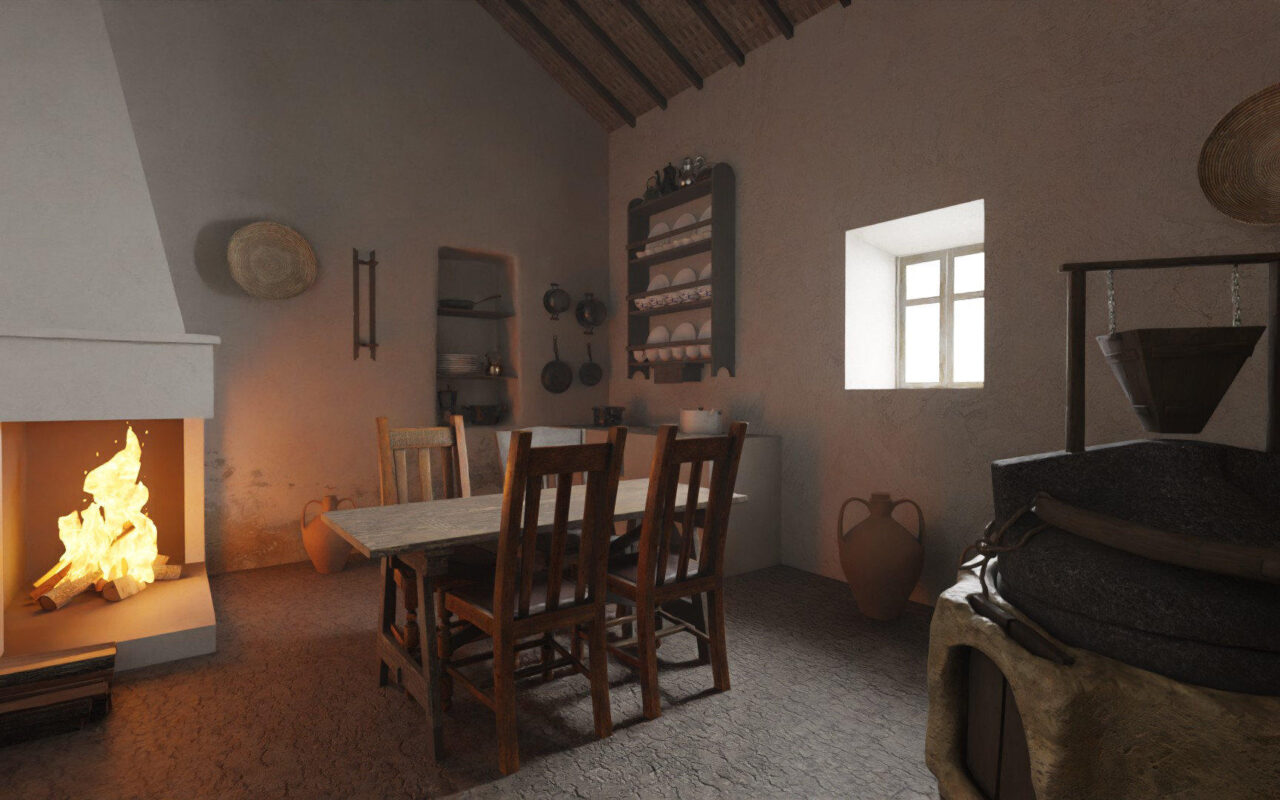
Contemporary graphic design has expanded its boundaries beyond the visual realm to become a tool for historical and emotional reconstruction. In this project, 3D technology is used to preserve family memories through the virtual recreation of a Campidanese house that belonged to my great-grandparents, Celestino Caria and Grazia Marras. Located in Villanovafranca, a small village in the Sardinian hinterland, this house was built in the late 19th century and demolished in the 1960s. Through digital techniques, it has been possible to restore form, volume and life to a space that no longer physically exists, but which remains present in our memories.
Historical and architectural context
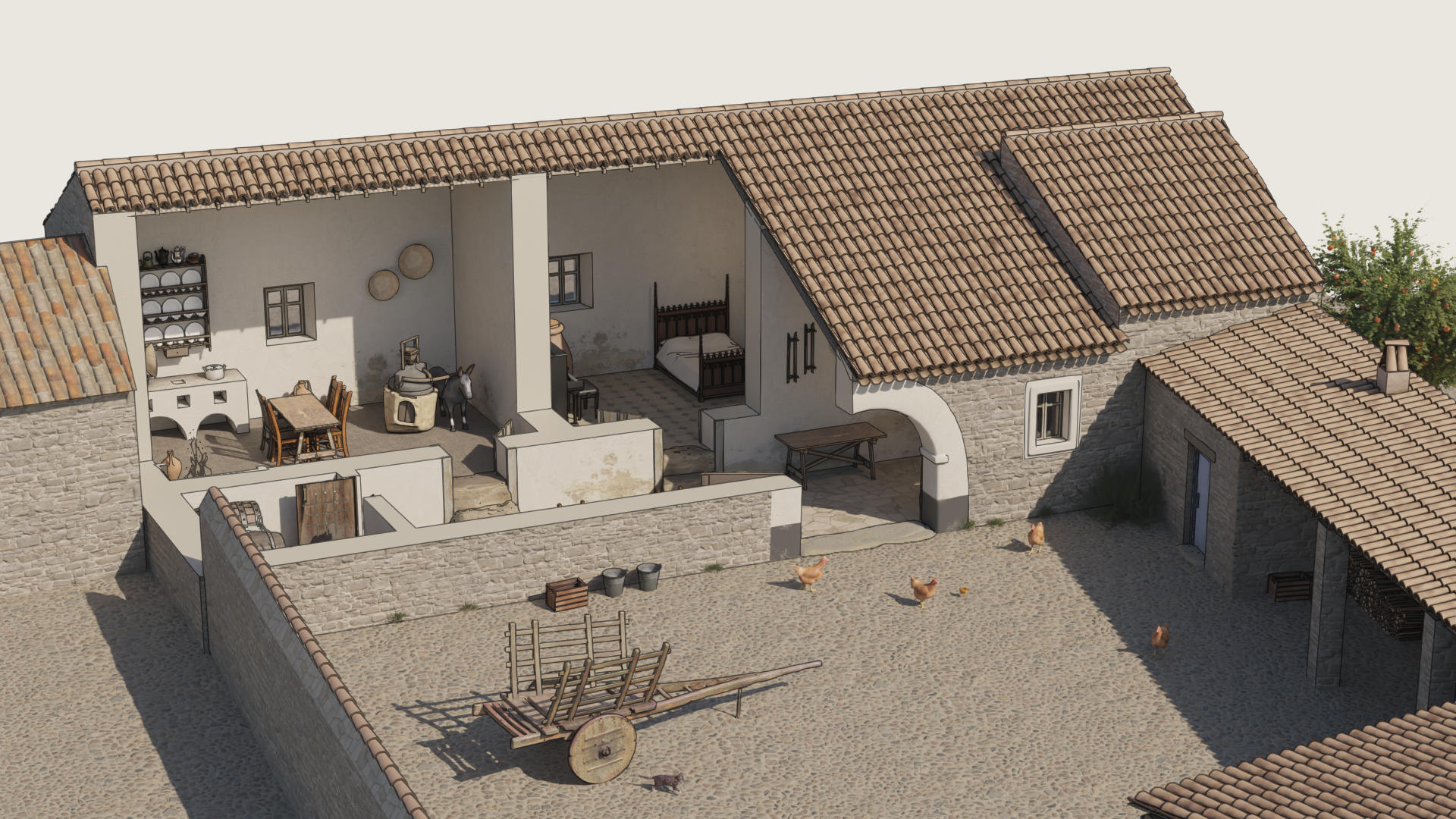
Campidanese houses are a faithful reflection of rural life in southern Sardinia. Generally built from stone, adobe, wood and tiles, these dwellings were organised around a central courtyard that served as the hub of domestic and agricultural life. My great-grandparents’ house was no exception: it featured rooms dedicated to both family life and work, including spaces for storing grain and tools.
Understanding this context was fundamental to tackling the reconstruction. It was not simply a matter of recreating an architectural structure, but of capturing a way of life. Every detail, from the layout of the rooms to the materials used, had to adhere to a precise historical and cultural logic.
Documentary sources: reconstruction from fragments
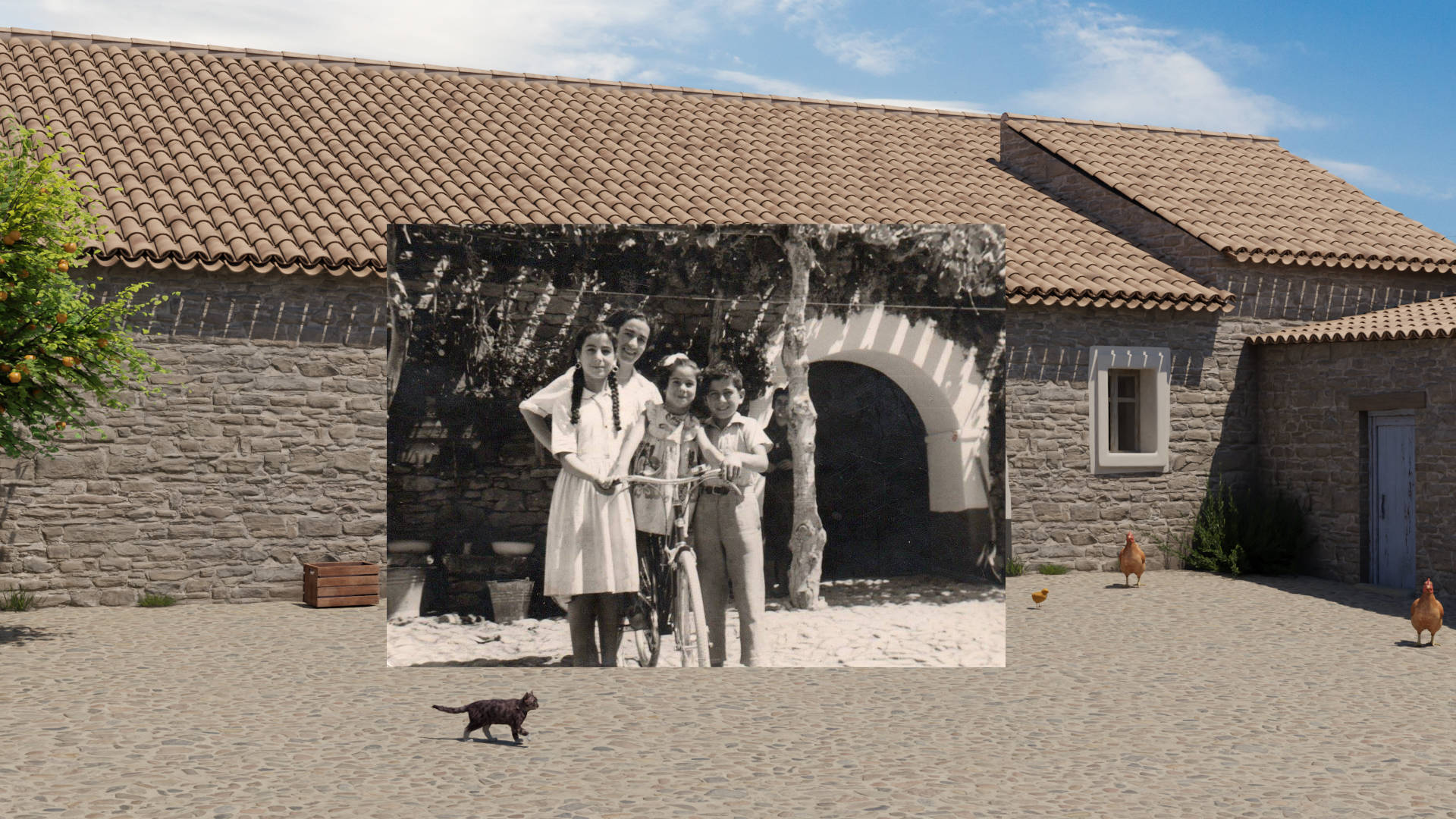
One of the main challenges of the project was gathering reliable information. As the building had disappeared over half a century ago, there were no complete plans or comprehensive technical documentation. However, a series of key materials were successfully gathered: old photographs, partial sketches and, above all, oral accounts from relatives who had lived in or visited the house.
These sources, although fragmentary, provided a solid basis for the reconstruction. The photographs offered visual references regarding façades, textures and proportions, whilst the accounts helped to understand the interior layout and the use of the spaces. Graphic design acted here as a bridge between incomplete data, interpreting and unifying the available information.
3D Modelling: Giving Shape to the Intangible
Once the information had been gathered, the next step was three-dimensional modelling. Using specialist software, a digital representation of the dwelling was constructed, starting with the basic structure and progressing to the finer details. This process involved making interpretative decisions, always based on the available sources, but also on an understanding of traditional Sardinian architecture.
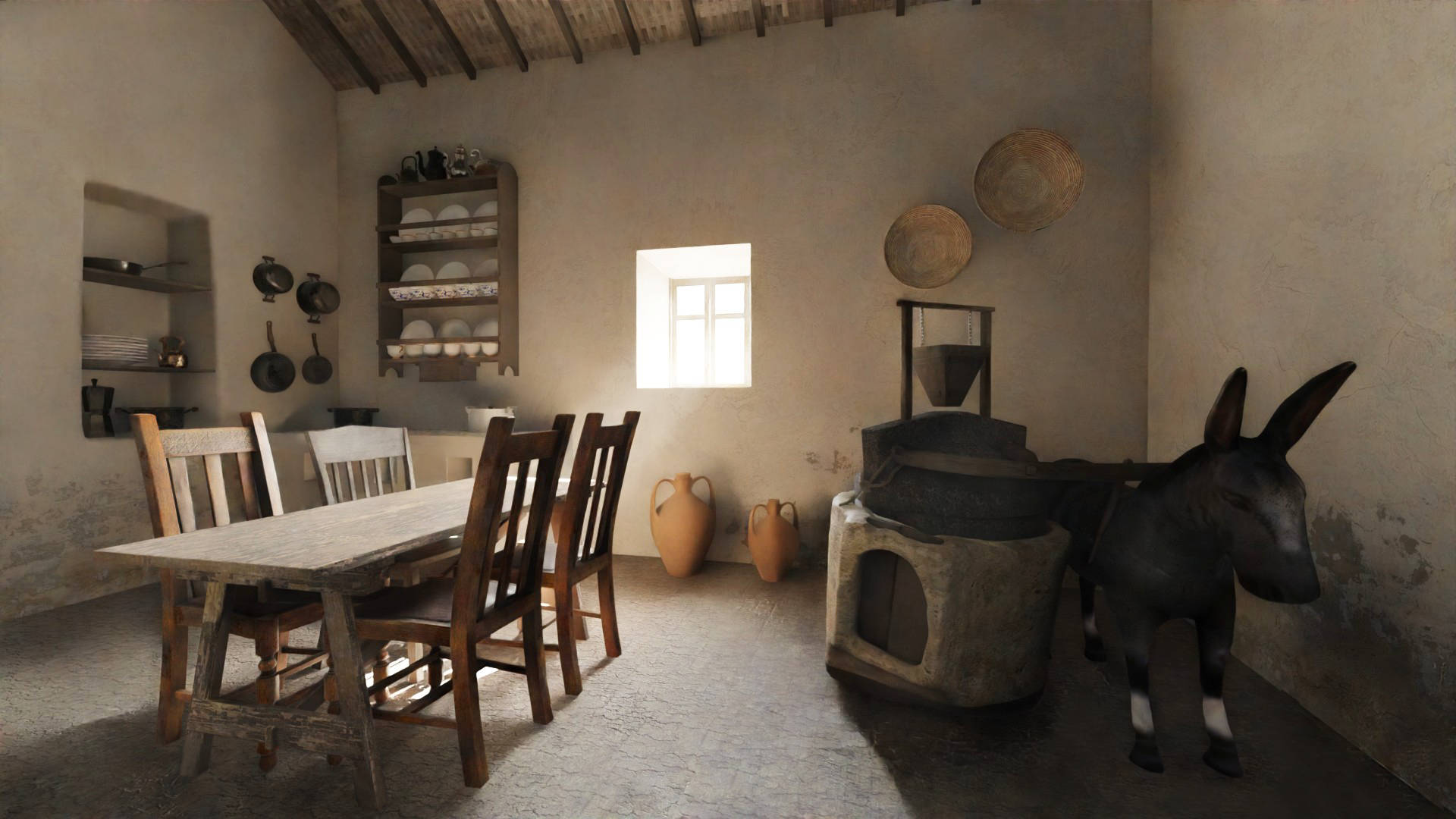
The modelling sought not only accuracy but also visual coherence. Proportions, lighting and materials were carefully adjusted to achieve a realistic representation. The result is a space that can be explored virtually, allowing one to experience the house from the inside.
Fotogrametría: rescatar los objetos originales
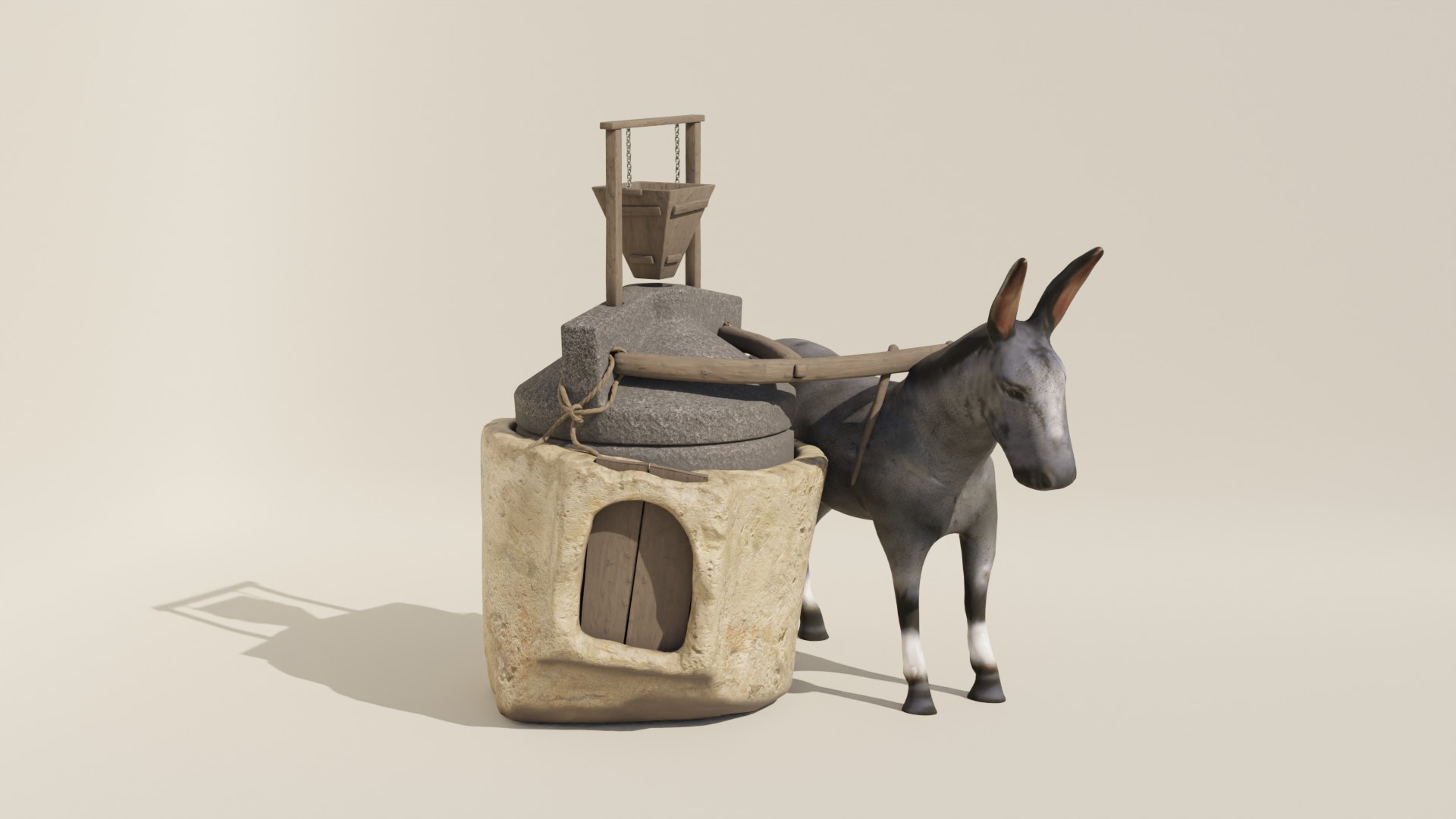
One of the most innovative aspects of the project was the use of photogrammetry to reconstruct original objects that had survived the passage of time. Among these, the millstone stands out as a key element in the daily life of the house. Using multiple photographs taken from different angles, a precise 3D model of this object was generated.
The integration of these real elements into the virtual environment adds an extra layer of authenticity. It is not just a matter of recreating a space, but of preserving tangible fragments of the past. Photogrammetry made it possible to capture details that would have been impossible to reproduce manually, such as surface irregularities or signs of wear.
Setting: furniture and everyday life
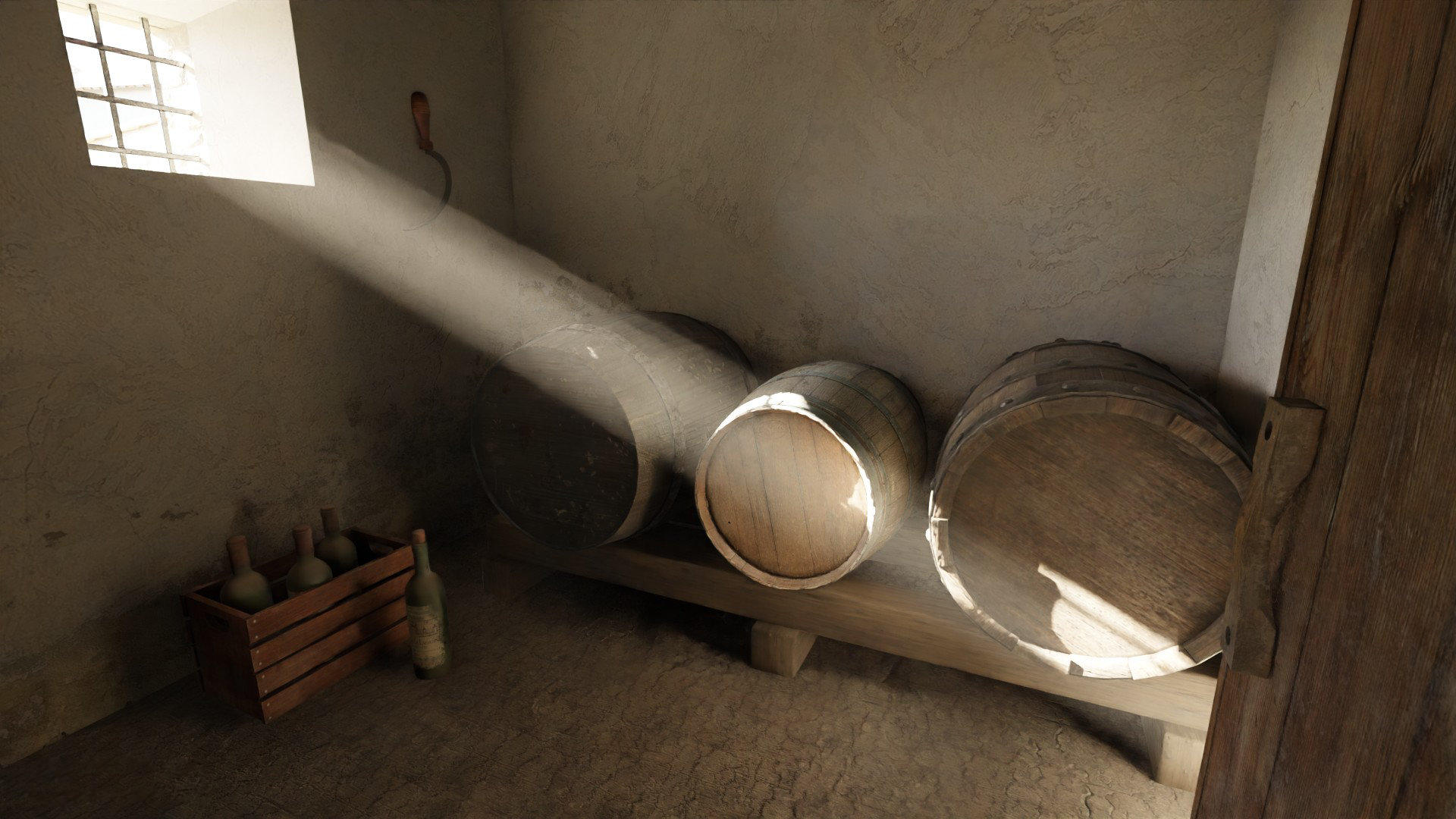
To complete the reconstruction, period furniture and objects were incorporated. Although not all of them originally belonged to the house, they were carefully selected to maintain historical accuracy. Iron beds, solid wood tables, kitchen utensils and agricultural tools all help to bring the space to life.
The setting was key to transforming the model into an immersive experience. The arrangement of the objects, the natural lighting and the small everyday details help visitors imagine what life was like in that house. In this sense, the graphic design not only depicts, but also evokes.
Conclusion: technology and shared memory
This project demonstrates how graphic design and 3D technologies can become powerful tools for heritage recovery, even when that heritage has physically disappeared. The reconstruction of the home of my great-grandparents, Celestino Caria and Grazia Marras, is not merely a technical exercise, but also an act of remembrance and tribute.
By combining historical documentation, testimonies and digital tools, a bridge has been built between the past and the present. Initiatives of this kind open up new possibilities for preserving family and cultural histories, transforming memories into accessible and lasting visual experiences.
Would you like to explore this reconstruction in detail? View the full 3D tour, the digitised objects and the step-by-step process by accessing the full project.
If you’re interested in developing a similar reconstruction, 3D visualization projects, or any graphic design work focused on heritage or visual memory, we’d be delighted to help — get in touch!